Money & Currency Exchange in Myeongdong
Paying for a day in Myeongdong is easy once you know two things: how widely cards are accepted, and where to turn your money into Korean won. This guide covers both — which payments are still cash-only, where the exchange counters and 24-hour machines are, the passport and customs rules, and how Korea's tourist prepaid cards compare. It is the money page for the district: short answers first, then the detail you need before you arrive.
The short answer
Card first, a little cash second. Visa, Mastercard and American Express are accepted in almost every Myeongdong store, restaurant, department store and hotel — but street-food carts and some small stalls still run on cash. Get won at a Myeongdong exchange counter (generally 10:00–21:00 daily) or a self-service "Money 24h" machine (open around the clock), and bring your passport, because ID is required to exchange currency in Korea. Exchange counters take cash only — you cannot buy won with a credit or debit card.
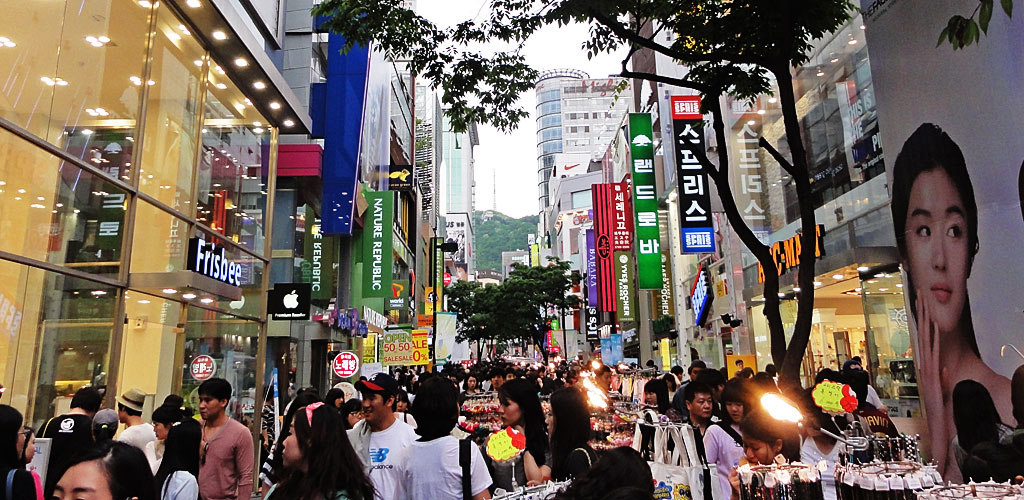
Myeongdong's pedestrian core is card-friendly, but the street-food carts that appear in the late afternoon are where a little cash still matters.
Cash or card in Myeongdong?
Korea is one of the most card-friendly countries in Asia, and for most of a Myeongdong day you will not need cash at all. Credit cards are accepted in most stores, restaurants, hotels and tourist destinations nationwide, in any amount, large or small, and the major international networks — Visa, Mastercard and American Express — are all taken. That covers the department stores at the Lotte cluster and Shinsegae, the big K-beauty flagships such as Olive Young and 3CE Stylenanda, cafés, chain restaurants and your hotel.
Cash still has a place, and it is a small one. The street-food carts that set up along Myeongdong-gil from late afternoon are the traditional cash economy of the district, and a minority of stalls are cash-only or have a card minimum — this is commonly reported by visitors rather than written into any official rule, so treat it as a reason to carry a little cash rather than a guarantee.
How much cash to carry: think in terms of one evening's snacks rather than a whole trip. If your plan is a meal, drinks and two or three street-food items per person, a few tens of thousands of won in small notes covers it comfortably and everything else can go on a card. Small notes and coins are more useful than a single large bill: exact change speeds up service at a busy stall, and a ₩50,000 note is awkward to break at a cart that only sold you a ₩3,000 skewer.
Where to exchange won in Myeongdong
You have four realistic options in the district, and they differ on hours, what you can pay with, and what you need to show. The table below is the practical comparison; the rules behind it are explained underneath.
| Where | Hours | Paid with | ID | Notes |
|---|---|---|---|---|
| Money exchange counter (private, Myeongdong) | Generally 10:00–21:00 daily | Cash only | Passport or residence card | 20 currencies handled; no commission or service fee |
| Self-service "Money 24h" machine | 24 hours, every day | Cash only | Passport or ID scanned at the machine | 16 currencies handled; useful outside counter hours |
| Bank exchange office | Bank opening hours (closed weekends) | Cash only | Passport or residence card | Also handles traveller's cheques |
| Hotel front desk | Usually 24 hours for guests | Cash only | Passport | Convenient, but rates are typically the least favourable |
For the best mix of hours and convenience, the private counters and the 24-hour machines around the Myeongdong shopping streets are the ones most visitors end up using. One operator, Money Box, runs both — a staffed counter in Myeongdong plus self-service "Money 24h" currency-exchange machines — and publishes the hours, currency counts and fee policy used above. Booths in the Myeongdong area, particularly around the Chinese Embassy end of the district, are commonly reported by visitors to offer better rates than banks or hotels; treat that as a rule of thumb, not a published fact, and never chase a rate you have not seen displayed.
No exchange rates on this page — on purpose
Currency rates are not officially published and change through the day, so any number printed here would be wrong by the time you read it. Always compare the rate displayed at the counter before you hand over your money.
What you need to exchange money
Your passport. You are required to present a passport or residence card when exchanging currency in Korea. This applies at staffed counters and at the self-service machines, where the passport or ID is scanned as part of the kiosk flow. Carry the physical document — a photo on your phone will not do — and expect the same requirement when you claim a tax refund.
Cash, not card. This is the rule visitors are most often caught out by: only cash is accepted to exchange currency. Credit and debit cards cannot be used to buy won, so you cannot walk into a counter with an empty wallet and pay by card. Bring the foreign notes you want to convert.
The US$10,000 declaration line. You can exchange up to US$10,000 at a time. Anything above that requires a customs declaration. Separately, if you want to exchange more than ₩10,000,000, the operator will ask for documents proving where the money came from. Both rules are legal requirements, not shop policy.
Fees and currencies. A typical Myeongdong exchange counter handles around 20 foreign currencies, with self-service machines covering a slightly smaller set (about 16), and charges no commission or separate service fee — the margin is built into the displayed rate. Foreign coins cannot normally be exchanged; only KRW coins are handled.
Tourist prepaid cards: WOWPASS vs T-money vs Climate Card
Korea's three tourist cards solve different problems. T-money is the classic transit card; WOWPASS combines transit with a payment card and currency exchange; the Climate Card is a flat-rate unlimited travel pass for Seoul. All three are sold in or near Myeongdong.
| Card | What it does | Cost | Where to get it | Top-up / balance |
|---|---|---|---|---|
| WOWPASS | Foreigner-exclusive prepaid card: payments and currency exchange, with a T-money transit function | ₩5,000 | WOWPASS app or kiosks at major airports, subway stations and hotels (~430 locations) | Load KRW or foreign currency at a kiosk; unused balance can be withdrawn as KRW cash at a kiosk |
| T-money | Standard rechargeable transit card for subway, buses and taxis, plus affiliated stores | ₩3,000–5,000 | Convenience stores and Seoul subway station information centres (Lines 1–8) | Reload at station vending machines, up to ₩500,000 |
| Climate Card | Seoul unlimited-travel transit pass (flat rate for the chosen number of days) | Card ₩3,000; 1/2/3/5/7-day passes ₩5,000 / 8,000 / 10,000 / 15,000 / 20,000 | Myeongdong Tourist Information Center | Pass is valid for the purchased period; no per-ride loading |
Which to choose. If you will ride the subway a few times a day for several days, the Climate Card's flat rate is the simplest deal and it is sold at the Myeongdong Tourist Information Center. If you want one card for both transport and shop payments — and you want a machine that converts your foreign cash into won-loaded balance — WOWPASS is the one built for visitors, but remember it requires your passport to buy and costs ₩5,000. T-money remains the cheapest, most universal fallback: buy it at any convenience store, top it up at a station machine, and it works everywhere in the city. For how these cards fit into arriving, fares and airport transfers, see our How to Get to Myeongdong page.
ATMs in Myeongdong
You will find ATMs at banks, subway stations and convenience stores throughout Myeongdong and the surrounding Jung-gu streets. The ones that matter to a visitor are those marked "Global" or carrying the international network logos (Cirrus, Plus, Visa, Mastercard) — these accept foreign cards, while many ordinary Korean ATMs do not. Convenience-store ATMs are the most reliable after bank hours and are usually open late.
One habit saves money: if the machine or the card terminal offers to charge you in your home currency rather than in won, decline it and choose to pay in KRW. That "dynamic currency conversion" rate is set by the machine operator, not the interbank market, and is almost always worse than letting your own bank convert. The same rule applies at card terminals in shops.
Tax refund in one line
If you are shopping rather than just eating, the practical threshold is a minimum spend of ₩15,000 per receipt, claimed with your passport (minimums, per-purchase and per-trip ceilings differ, and downtown refund booths have their own limit). This site already covers the refund ruleset in detail elsewhere — start with the tax-refund section of our Myeongdong shopping guide rather than repeating it here.
Practical FAQ
Do I need my passport to exchange money in Myeongdong?
Yes. A passport or residence card is required to exchange currency in Korea, at both staffed counters and self-service machines. Bring the physical document.
Can I pay for currency exchange by card?
No. Exchange counters and machines accept cash only; credit and debit cards cannot be used to buy won. Cards are accepted for purchases in nearly all shops, which is a different transaction.
Do I need cash for Myeongdong street food?
Not always, but it helps. Most vendors accept cards, yet cash-only stalls and card minimums do exist among the carts that appear from late afternoon. Carry a small amount of cash in low denominations for an evening's snacks.
How much cash should I carry for one evening?
Enough for snacks and drinks rather than a whole trip — a few tens of thousands of won per person covers a night of street food comfortably, with larger meals and shopping put on a card.
Where can I exchange money late at night?
Self-service "Money 24h" currency-exchange machines in the Myeongdong area run 24 hours a day, every day, which covers hours when the staffed counters (generally 10:00–21:00) are closed.
Is there a fee to exchange currency?
Typical Myeongdong operators charge no commission and no separate service fee; the cost is built into the displayed rate, which is why comparing the rate matters more than hunting for a fee.
Where is the Myeongdong Tourist Information Center?
It is the place to buy a Climate Card and pick up maps and English-language help in the district. For wider visitor assistance, the Korea Travel Helpline runs 24/7 in multiple languages on 1330 (from abroad, +82-2-1330).
Where this fits
Money is the practical layer under everything else in the district: it decides how you pay, how much you carry, and how quickly you move. Once you have that sorted, the useful next pages are our Myeongdong shopping guide for stores and the tax refund, How to Get to Myeongdong for transport cards and arrival, opening hours so you know when shops and stalls trade, and the site sitemap for everything else on Myeongdong.
Before you leave the hotel
Passport: in your bag, not the safe — you need it for exchange and tax refunds.
Cash: some low-denomination won for street-food carts.
Cards: Visa, Mastercard or Amex for everything else.
Terminal rule: if asked, pay in KRW, never in your home currency.